
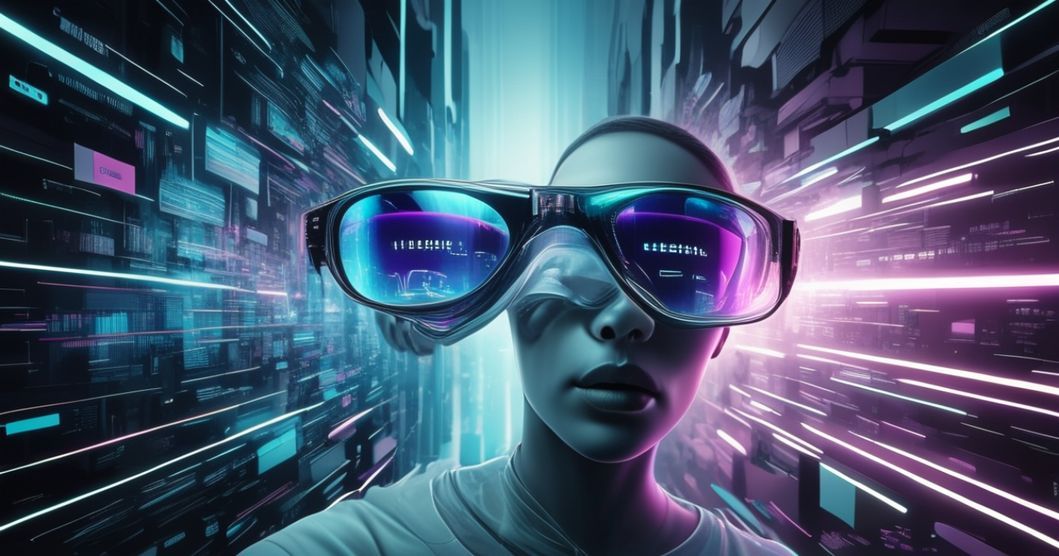
We stand on the cusp of a profound shift in how we interact with digital information and the world around us. For years, augmented reality (AR) has been a fascinating concept, largely confined to science fiction or niche enterprise applications. However, recent technological leaps are rapidly bringing sophisticated AR glasses from laboratories and developer kits into the realm of consumer reality. These aren’t just glorified smartwatches for your face; they represent a fundamental reimagining of our digital interface, promising to seamlessly blend the virtual with the physical and redefine our daily lives.
Imagine a world where directions float unobtrusively over city streets, where colleagues appear as lifelike holograms in your living room, or where complex repair instructions overlay directly onto a faulty engine. This isn’t a distant dream; it’s the future that advanced AR glasses are meticulously crafting. As major tech players pour resources into this domain, the question is no longer if AR glasses will become mainstream, but when and how they will transform our existence.
What Are Advanced AR Glasses?
At their core, advanced AR glasses are wearable computing devices that overlay digital information onto a user’s real-world view. Unlike virtual reality (VR) headsets, which completely immerse users in a simulated environment, AR glasses maintain your connection to the physical world while enhancing it with computer-generated elements. This enhancement can range from simple notifications and data displays to complex 3D models and interactive interfaces, all appearing as if they naturally exist in your surroundings.
The latest generation of these devices goes far beyond previous iterations. They are designed to be more compact, comfortable, and powerful, integrating cutting-edge optics, sensors, and artificial intelligence to deliver truly immersive and intuitive experiences. They aim to be an extension of our senses, providing relevant information and interaction without demanding our full attention away from the real world.
Key Innovations Driving the AR Revolution
The journey from clunky prototypes to sleek, functional AR glasses has been powered by several critical technological breakthroughs:
Crystal-Clear Optics and Displays
One of the biggest hurdles for AR glasses has always been projecting high-quality digital images onto transparent lenses without obstructing the wearer’s vision. Recent advancements in waveguide technology, micro-LED displays, and holographic projection allow for brighter, sharper, and more vibrant visuals with a wider field of view. Companies are experimenting with different projection methods to create displays that are both unobtrusive and incredibly detailed, making digital objects appear remarkably lifelike and stable in the real world.
Powerful Processors and AI Integration
Running complex AR applications requires significant processing power. Miniaturized, energy-efficient chipsets capable of real-time spatial mapping, object recognition, and gesture tracking are crucial. These processors, often enhanced by dedicated AI engines, enable glasses to understand the environment, track eye and hand movements, and interpret voice commands with unprecedented accuracy. This AI integration is key to creating truly interactive and context-aware AR experiences.
Seamless Interaction and Connectivity
Beyond visual overlays, advanced AR glasses are focusing on intuitive interaction. This includes precise eye-tracking for selection, subtle hand gestures for manipulation, and natural voice commands for control. Furthermore, robust connectivity – including Wi-Fi 6E, 5G, and Bluetooth – ensures low-latency communication with other devices and cloud services, enabling rich, collaborative, and always-updated AR experiences.
Beyond the Hype: Real-World Applications
The potential applications for advanced AR glasses are vast and span across numerous sectors:
- Work and Productivity: Imagine engineers collaborating on a 3D model of a new engine that appears right in front of them, or surgeons accessing patient data and real-time vital signs overlaid during an operation. AR glasses can provide professionals with hands-free access to critical information, enhancing efficiency and accuracy.
- Education and Training: Students could explore historical sites in 3D, dissect virtual organs, or conduct complex chemistry experiments without the need for physical labs. Training for complex machinery or procedures can be made safer and more effective through interactive AR simulations.
- Navigation and Travel: Directions could be overlaid directly onto your path, points of interest highlighted as you walk by, and foreign languages instantly translated and displayed in your line of sight, making travel more accessible and informative.
- Gaming and Entertainment: While VR offers full immersion, AR brings games into your living room or even outdoors. Imagine battling digital creatures that appear to be hiding behind your furniture or playing interactive scavenger hunts in your local park.
- Social Connection: Future iterations could enable virtual avatars of friends or family to appear in your space, allowing for more immersive and intimate remote interactions.
Navigating the Challenges Ahead
Despite the immense promise, several hurdles remain before AR glasses become as ubiquitous as smartphones:
- Form Factor and Comfort: To achieve mass adoption, AR glasses need to be stylish, lightweight, and comfortable enough for all-day wear, resembling regular eyeglasses as much as possible.
- Battery Life: Powering sophisticated displays, sensors, and processors in a compact device requires significant energy, making extended battery life a critical design challenge.
- Cost: Cutting-edge technology often comes with a hefty price tag. For widespread consumer adoption, costs will need to come down significantly.
- Privacy and Ethics: The ability to constantly record, analyze, and display information about the real world raises important questions about privacy, data security, and potential misuse.
- Digital Eye Strain: Prolonged use of AR displays, even advanced ones, could potentially lead to eye strain or discomfort, necessitating ergonomic design and responsible usage patterns.
The Road to Widespread Adoption
The journey towards mainstream AR glasses is undoubtedly complex, but the momentum is undeniable. Companies like Apple, Meta, Google, and Magic Leap are investing heavily, pushing the boundaries of what’s technically possible and addressing the practical challenges. We’ve already seen groundbreaking devices like the Apple Vision Pro and Meta Quest 3, which, while more VR-leaning, showcase incredible spatial computing capabilities that will inform the future of pure AR glasses.
As these technologies mature, become more affordable, and seamlessly integrate into our lives, AR glasses have the potential to transcend being just another gadget. They could fundamentally alter how we perceive and interact with information, each other, and the world itself, ushering in an era where the digital realm is no longer confined to screens, but an integral, enriching layer of our everyday reality.