
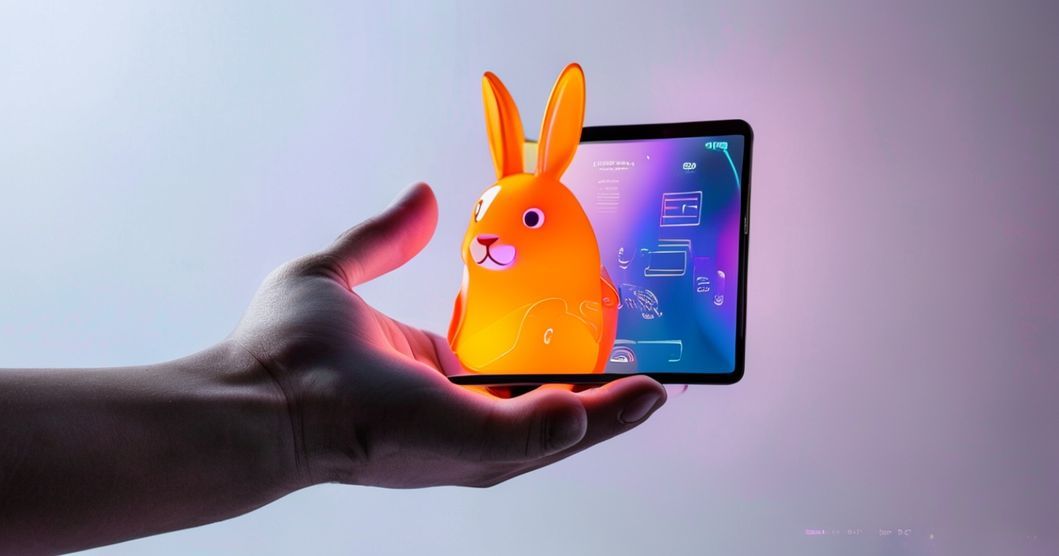
In a world increasingly saturated with apps and endless digital notifications, a new contender has emerged, promising a refreshing take on how we interact with technology. Enter the Rabbit R1, a compact, vibrant orange device that aims to simplify our digital lives by acting as a universal AI-powered assistant. Unveiled at CES 2024, the R1 has quickly captivated the tech world, sparking both excitement and intense debate about its potential to redefine human-computer interaction.
What is the Rabbit R1?
The Rabbit R1 is not a smartphone, nor is it merely a smart speaker. Instead, it positions itself as a standalone AI companion, designed to perform tasks across various applications and services on your behalf, without you ever having to open an specific app. Shaped like a square, retro-futuristic gadget, it features a 2.88-inch touchscreen, a rotating camera called the “Rabbit Eye,” a scroll wheel, and a push-to-talk button. Its core philosophy revolves around minimizing friction and maximizing efficiency in managing your digital world.
The Vision: Simplifying Digital Overload
The creators of Rabbit Inc. identified a growing frustration: the paradox of choice and complexity in our app-driven ecosystem. We navigate endless interfaces and juggle subscriptions. The R1’s vision is to cut through this clutter. Imagine telling a single device to order you a pizza, book a ride, or play a specific song – and it just does it, seamlessly integrating with your existing services. This is the promise of the R1: a unified, intelligent agent for your digital tasks.
How the Rabbit R1 Works: The Large Action Model (LAM)
At the core of the R1’s capabilities lies its proprietary operating system, Rabbit OS, powered by the Large Action Model (LAM). Unlike traditional large language models (LLMs) that focus on understanding text, the LAM is trained to understand human intent and execute actions across various interfaces. Instead of developers building specific integrations, the LAM learns to use apps by observing human interaction. It’s like having a digital assistant that learns to navigate any app you can.
Key Features at a Glance:
- Push-to-Talk Interface: A dedicated button for voice commands, offering a direct, conversational feel.
- Rotating “Rabbit Eye” Camera: Swivels 360 degrees for object identification, text translation, or video calls.
- Scroll Wheel: For tactile navigation of menus and settings.
- Rabbit OS: The intuitive operating system unifying digital services under AI.
- “Teach Mode”: Allows users to teach the LAM custom actions on websites or apps.
A Glimpse into the User Experience
Using the Rabbit R1 is intuitive and direct. You hold the push-to-talk button, articulate your request, and the R1 processes it. Want a coffee order or to schedule a meeting? Just ask. The device aims to free users from the cognitive load of switching apps and learning new interfaces, delegating tasks to an intelligent agent.
Potential Applications and Everyday Use Cases
Its versatility spans numerous daily scenarios:
- Travel & Navigation: Booking flights, hotels, routes, or rideshares.
- Productivity: Managing calendars, reminders, emails, summaries, or smart home devices.
- Entertainment: Playing music, podcasts, or videos on preferred streaming platforms.
- Shopping: Finding products, comparing prices, and completing purchases online.
- Information Retrieval: Instant answers, language translation, or object identification with its camera.
“Teach Mode” further enhances this, allowing users to automate specific, repetitive tasks.
Challenges and Criticisms on the Horizon
Despite its ambitious vision, the Rabbit R1 faces significant hurdles and has drawn its share of skepticism. Critics raise concerns about:
- Privacy & Security: Access to personal accounts raises data handling and security questions.
- Reliability & Accuracy: LAM’s ability to consistently perform complex tasks across diverse and changing web interfaces is crucial, especially with UI updates.
- Internet Dependence: Heavy reliance on constant internet, limiting utility in areas with poor connectivity.
- Redundancy: Smartphones, with voice assistants and apps, offer similar functions. R1 must prove it’s genuinely better.
- Learning Curve for LAM: While “Teach Mode” is innovative, teaching the LAM might itself introduce new complexity.
Initial launches have also seen criticism regarding the device’s actual performance matching initial hype, with some users reporting current limitations.
The Future of AI Hardware: A New Paradigm?
The Rabbit R1 represents a bold step in AI hardware, moving beyond smart speakers or app interfaces towards autonomous agents. It challenges the smartphone’s dominance and prompts reconsideration of how we engage with technology. Whether mainstream or niche, its underlying philosophy – intelligent agents acting for users – is likely to shape tech’s future. This signifies a potential shift from “app-centric” to “intent-centric” computing, prioritizing user intent over specific apps.
The Rabbit R1 is more than just a gadget; it’s a statement about our increasingly complex digital lives and an attempt to simplify them. Its journey will be a fascinating one to watch, as it navigates the high expectations, technical challenges, and the inherent human desire for technology that truly serves us.