
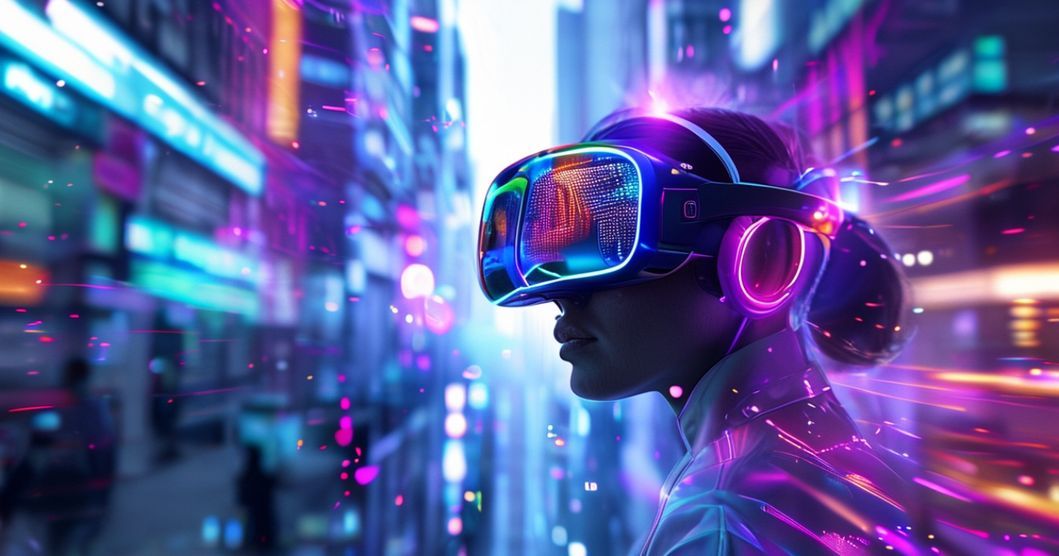
In the rapidly evolving landscape of immersive technology, the Meta Quest 3 stands out as a pivotal device, heralding a new era for virtual and mixed reality. Launched as the successor to the immensely popular Quest 2, this headset isn’t merely an upgrade; it’s a significant leap forward, designed to bridge the gap between the digital and physical worlds. With enhanced capabilities and a sharper focus on mixed reality, the Quest 3 is poised to redefine how we interact with technology, entertainment, and even our everyday environments.
For years, virtual reality has promised complete immersion, transporting users to entirely digital realms. While captivating, the isolation from the real world has sometimes been a barrier. The Quest 3 addresses this directly by championing mixed reality (MR), an experience that seamlessly blends digital content with your physical surroundings. This isn’t just about seeing your room while wearing a headset; it’s about digital objects realistically interacting with your furniture, walls, and even other people in the room. This innovation unlocks a host of new possibilities, moving beyond mere gaming to practical applications that integrate deeply into our daily lives.
The Dawn of Seamless Mixed Reality
At the heart of the Meta Quest 3’s mixed reality prowess are its dual RGB color passthrough cameras. These high-resolution cameras provide a full-color, stereoscopic view of the user’s surroundings, rendering them with remarkable clarity and minimal latency. Unlike previous black-and-white passthrough experiences, the Quest 3 makes the real world visible and vibrant, allowing digital elements to appear as if they genuinely exist within your space. This fundamental improvement is what truly differentiates it from its predecessors and many competitors.
Beyond just seeing your environment, the Quest 3 employs advanced spatial understanding technology. This means the headset can accurately map your room, detecting surfaces, walls, and even objects. Developers can then leverage this data to create experiences where virtual characters walk around your coffee table, digital games are played on your living room floor, or productivity apps cast large virtual monitors onto your real-world wall. It creates a powerful sense of presence and interaction, making the boundary between the physical and virtual delightfully porous.
Unpacking Key Features and Enhancements
Beyond its mixed reality capabilities, the Quest 3 boasts a suite of hardware upgrades that significantly enhance the overall user experience.
Stunning Visuals and Optics
The display resolution has seen a substantial bump, offering 2064×2208 pixels per eye – a nearly 30% increase over the Quest 2. This translates to incredibly sharp visuals, reduced screen-door effect, and a more comfortable viewing experience. Coupled with Meta’s innovative Pancake lenses, the Quest 3 achieves a wider field of view (110 degrees horizontal and 96 degrees vertical) and a much slimmer optical profile. The result is clearer, brighter, and more expansive visuals with fewer distortions, making text easier to read and virtual worlds more convincing.
Next-Gen Performance
Powering these enhanced visuals is the new Snapdragon XR2 Gen 2 platform, custom-built in collaboration with Qualcomm. This chipset delivers more than double the GPU processing power compared to the Quest 2’s XR2 Gen 1. This significant boost in performance allows for more complex applications, higher fidelity graphics, faster loading times, and smoother frame rates, ensuring a truly premium immersive experience across all types of content. With 8GB of RAM, up from 6GB, multitasking and running demanding applications become more fluid.
Enhanced Comfort and Design
Meta has also paid close attention to ergonomics. The Quest 3 is 40% slimmer than the Quest 2, primarily due to the Pancake lenses, making it less bulky and more comfortable to wear for extended periods. The weight distribution has been optimized, and a new soft strap improves fit and stability. While it still uses a fabric strap out of the box, the improved balance makes a noticeable difference in long-term comfort, reducing pressure points on the face.
Revolutionary Touch Plus Controllers
The redesigned Touch Plus controllers are another highlight. They are sleeker, lighter, and crucially, lack the large tracking rings of previous models. This streamlined design makes them less cumbersome and more natural to hold. Integrated TruTouch haptic feedback delivers more nuanced and realistic sensations, from the subtle click of a virtual button to the impact of a digital weapon. Hand tracking has also been significantly improved, offering a controller-free interaction option that feels increasingly intuitive and responsive.
Immersive Applications and Use Cases
The Meta Quest 3’s enhanced capabilities unlock a vast array of applications, stretching far beyond traditional VR gaming:
- Gaming Revolution: Existing VR titles receive graphical updates, and new mixed reality games offer unprecedented interaction with your physical space, transforming your home into an interactive playground.
- Productivity and Collaboration: Imagine setting up multiple virtual monitors around your room for work, collaborating with colleagues as avatars in shared virtual spaces, or conducting meetings with virtual whiteboards that appear in your office.
- Fitness and Wellness: MR fitness apps can project trainers or workout environments directly into your living room, allowing you to exercise without bumping into furniture, with real-time feedback overlaid on your actual surroundings.
- Education and Training: From virtual dissections in science classes to simulating complex machinery in vocational training, the Quest 3 can offer highly interactive and engaging learning experiences that blend digital information with physical contexts.
Navigating Challenges and Future Prospects
While the Meta Quest 3 is a monumental step forward, it’s not without its considerations. Battery life, like many powerful portable devices, hovers around 2-3 hours for intensive use, necessitating frequent recharges or external battery packs for longer sessions. The price point, while competitive for the technology offered, remains a significant investment for many. Furthermore, the burgeoning ecosystem of mixed reality content is still in its early stages, though it’s growing rapidly with Meta’s continued investment and developer support.
The Meta Quest 3 represents more than just a new gadget; it’s a tangible step towards the future of spatial computing. By making mixed reality accessible and genuinely functional, Meta is laying crucial groundwork for what many believe will be the next major computing platform after the smartphone. It’s a device that encourages us to look at our surroundings with new eyes, envisioning a world where digital information and experiences are not confined to screens but seamlessly integrated into the fabric of our everyday lives, enriching our interactions and expanding our perceptions of reality.