
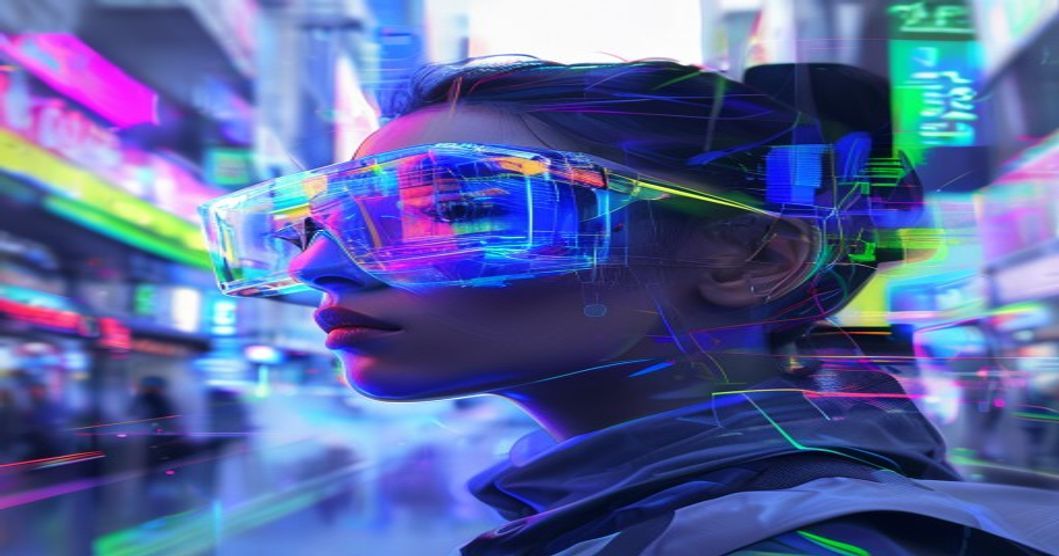
Imagine a world where digital information seamlessly integrates with your physical surroundings. A world where navigation arrows float above real streets, product details appear when you look at an item, and you can chat with a virtual assistant projected directly into your field of view. This isn’t just science fiction anymore; it’s the promise of Augmented Reality (AR) glasses, a technological innovation rapidly moving from experimental labs to the cusp of mainstream adoption.
For years, AR was largely confined to smartphone apps, overlaying digital elements onto a camera feed. While impressive, it still required holding up a device. AR glasses, however, aim to make this experience truly immersive and hands-free, offering a continuous digital layer over your perception of reality. The journey has been long, but recent breakthroughs suggest we’re on the verge of a significant shift in how we interact with technology and the world around us.
The Evolution of Wearable AR
The concept of AR glasses isn’t new. Early pioneers like Google Glass captivated attention but ultimately struggled with social acceptance, bulky designs, and a lack of compelling applications. Devices like Microsoft’s HoloLens demonstrated incredible enterprise potential but remained prohibitively expensive and somewhat unwieldy for everyday use. These initial attempts laid crucial groundwork, highlighting both the immense potential and the significant hurdles to overcome.
Fast forward to today, and a new generation of AR glasses is emerging, sleek enough to be mistaken for regular eyewear. Companies like Xreal (formerly Nreal), Ray-Ban Stories (developed with Meta), and Magic Leap, alongside rumored entries from tech giants like Apple, are pushing the boundaries. They are leveraging advancements in miniaturization, processing power, and display technology to create devices that are lighter, more comfortable, and increasingly powerful, making the vision of omnipresent digital assistance a tangible reality.
Key Innovations Driving the Shift
What makes these new AR glasses different? It’s a convergence of several critical technological innovations:
- Advanced Optics and Displays: The shift from traditional displays to sophisticated waveguide optics or birdbath optical engines allows for thinner, lighter lenses that project vibrant, high-resolution images directly into your line of sight without obstructing your view of the real world.
- Miniaturized Processing Power: Modern AR glasses often offload heavy processing to a connected smartphone or feature highly efficient, custom-designed chips. This reduces the size and weight of the glasses themselves while providing ample computational power for complex AR experiences.
- Contextual Awareness via AI and Sensors: Equipped with multiple cameras, depth sensors, accelerometers, and gyroscopes, today’s AR glasses can accurately map their environment in real-time. Artificial intelligence algorithms then interpret this data, enabling sophisticated spatial anchoring of digital content and intuitive gesture controls.
- Improved Battery Efficiency: While still a significant challenge, advancements in power management and component efficiency are extending battery life, moving closer to all-day usability without constant recharging.
Beyond the Hype: Practical Applications
The real power of AR glasses lies in their ability to enhance and simplify various aspects of our lives, both personal and professional:
Everyday Life Enhancements
Imagine walking through an unfamiliar city and seeing turn-by-turn directions overlaid directly on the street ahead. Or effortlessly translating a foreign menu in real-time by simply looking at it. AR glasses promise a future where information is always available, contextually relevant, and seamlessly integrated. They could offer unobtrusive notifications, provide instant caller ID, or even help you find your keys by digitally highlighting their last known location.
Professional Productivity
For industries, the potential is transformative. In manufacturing, technicians could receive step-by-step assembly instructions projected onto their workpieces, reducing errors and training time. Healthcare professionals could access patient data during surgery without looking away from the operating table. Architects and designers could visualize 3D models of their creations superimposed onto real-world environments, facilitating better collaboration and decision-making. Field service engineers could get remote assistance from experts, seeing real-time annotations on the equipment they’re repairing.
Entertainment and Social Interaction
Beyond utility, AR glasses open new avenues for entertainment. Imagine engaging in a multiplayer game where virtual characters appear to interact with your living room furniture. Or attending a concert and seeing real-time lyrics or band trivia pop up. Shared AR experiences could redefine social interaction, allowing friends to experience digital content together in a shared physical space, blending reality and fantasy in novel ways.
Challenges and the Road Ahead
Despite the rapid progress, AR glasses still face hurdles. Achieving a truly lightweight, stylish form factor with all-day battery life remains a significant engineering feat. Social acceptance is crucial; will people embrace wearing these devices daily? Privacy concerns regarding always-on cameras and data collection also need careful consideration and robust solutions. Furthermore, a compelling ecosystem of applications and content is essential to drive mass adoption, moving beyond novelty to indispensable utility.
The future of AR glasses is intertwined with the evolution of artificial intelligence and the broader vision of the “spatial web” or metaverse. As AI becomes more sophisticated, AR glasses will transition from simply displaying information to proactively understanding our needs and context, offering predictive assistance. They could eventually become our primary computing interface, potentially even eclipsing smartphones as the go-to device for digital interaction. The journey is complex, but the destination promises a profoundly richer, more informed, and interactive reality.
The current generation of AR glasses marks a significant leap, bringing us closer to a future where the digital world doesn’t just reside in our pockets but dances fluidly within our line of sight. It’s a compelling vision where technology enhances, rather than distracts from, our engagement with the physical world.